 RU
RU DE
DE ES
ES FR
FR PT
PT IT
IT TR
TR ID
ID ZH
ZH JA
JA HI
HI HE
HE UK
UK AR
AR CS
CS EL
EL FI
FI LT
LT LA
LA NL
NL NO
NO PL
PL TH
TH TL
TL VI
VIDinosaur T-Rex Game
Google Dinosaur Record
Google Chrome Dino Game! Run, jump and clear obstacles endlessly by just pressing the space bar or up arrow. Down arrow - to sit down.
 EN
EN
Google Chrome Dino Game! Run, jump and clear obstacles endlessly by just pressing the space bar or up arrow. Down arrow - to sit down.


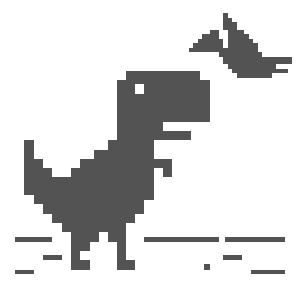 Imagine yourself browsing the web or watching a video and suddenly losing connectivity. Irritating, right? Well, with Chrome Dino, you might just wish you got kicked off the Internet more often! This friendly T-Rex will keep you company and have you entertained for hours on end.
Run, jump and clear obstacles endlessly by just pressing the space bar or up arrow. Survive as long as possible as the background color shifts from dark to light after you reach certain milestones. The game will stop once you fail to avoid the next obstacle or once your Internet connection is back.
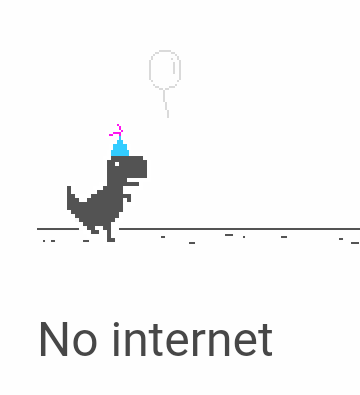 This clever offline dinosaur game is a nod to prehistoric times as represented by the main character, the T-Rex dinosaur living somewhere in the desert, and needing your help to avoid cacti and pterodactyls. Easily launched on mobile and desktop, the game can be easily started just by hitting the spacebar once you see the black dinosaur in your browser, a signal that you are no longer connected to the Internet. By hitting the spacebar, the dinosaur can easily leap over obstacles and pressing the down arrow can be used to duck.
 Conceived by developer Sebastien Gabriel, the game’s style is a great reference to the browser’s error illustrations. During the development stage, the game was christened ‘Project Bolan’ in honor of Marc Bolan, the frontman of the legendary rock band in the 1970s, “T-Rex”. First introduced in September 2014, the game did not work on earlier versions of Android OS and it was completed in December 2014.
Currently, 270 million Chrome Dino games are played every month on different platforms. The game is so popular that educational administrators had to be given a way to disable the game because school kids who were supposed to be in class, as well as adults who are supposed to be working, are all playing the game!
Today, you don’t have to disconnect from the Internet to play the T-Rex game. All you need to do is type “chrome://dino” in the browser address and you’ll soon see the game in a full window! Play on!